
Mastitis management with residue free milk production.
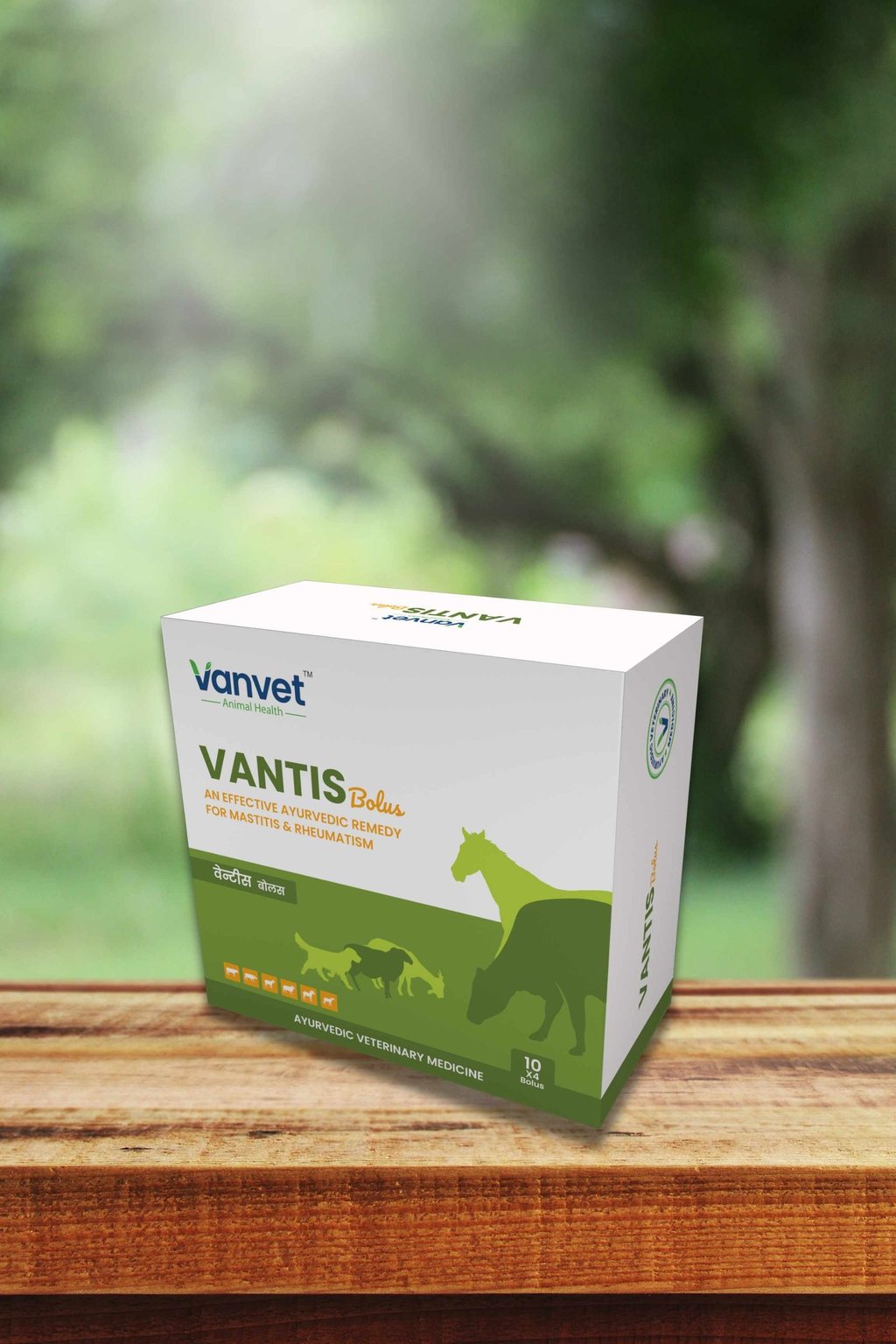
Discover Vantis Bolus, an Ayurvedic mastitis solution for dairy cows with zero withdrawal period. Ensure residue free milk production, improved udder health, and sustainable dairy farming.
Vanvet Private Limited
9/5/20254 min read
A New Era in Mastitis Management: Residue-Free Dairy with Vantis Bolus
India’s dairy industry is more than just an agricultural sector—it is the backbone of rural livelihoods, supporting over 80 million households and contributing significantly to the nation’s economy. Yet, one persistent challenge continues to erode productivity and profitability: bovine mastitis.
The Silent Drain on Dairy Productivity
Mastitis, an inflammation of the mammary gland, is widely recognized as the most economically devastating disease in dairy farming. It not only reduces milk yield but also alters milk quality, damages udder tissue, and increases treatment costs.
Clinical Mastitis: Visible signs like swelling, pain, and abnormal milk
Subclinical Mastitis (SCM): Silent yet responsible for 70–80% of total losses
Chronic Mastitis: The last stage of mastitis where the production loss and the damage is on the higher side.
Adding to this challenge is the global rise of antimicrobial resistance (AMR), which is steadily reducing the effectiveness of conventional antibiotic therapies. Moreover, antibiotic use necessitates a milk withdrawal period, leading to further economic losses and concerns about drug residues in milk.
The Need for a Sustainable Alternative
Modern dairy farming demands solutions that are:
Effective yet safe
Economically viable
Free from residue concerns
Aligned with global food safety standards
This is where Ayurveda-inspired veterinary science (Pashu Ayurveda) offers a transformative approach—combining time-tested herbal wisdom with modern therapeutic understanding.
Introducing Vantis Bolus: Science Meets Ayurveda
Developed by Vanvet, Vantis Bolus, a Pashu Ayurveda innovation, represents a new paradigm in mastitis management—a zero withdrawal, residue-free solution designed to address complete udder care.
It is a proprietary formulation enriched with 14+ potent Ayurvedic ingredients such as:
Ashwagandha (Withania somnifera)
Shallaki Extract
Haridra (Turmeric)
Guggul
Shudda aconite
Neem
Tulsi
Along with specialized mineral-herbal potentiators like Makardhwaja
Vantis Bolus is a scientifically designed Ayurvedic proprietary formulation that combines traditional wisdom with modern veterinary needs.
✔ Zero milk withdrawal period
✔ Residue-free milk production
✔ Sustainable alternative to antibiotics
✔ Supports animal welfare and farmer profitability
How Vantis Bolus Works: A Multi-Dimensional Approach
1. Ashwagandha (Withania somnifera):
Ashwagandha is one of the best rejuvenating agents that is popularly known as Indian Ginseng. It prevents stress-induced changes in adrenal function, enhances protein synthesis, and increases cell-mediated immunity in the body.
Ashwagandha leaf has antibacterial, antitumorous, antihepatotoxic, and anti-inflammatory properties. These properties are helpful in acute mastitis where the animal is in a toxaemic state with inflammatory changes in the mammary gland. Ashwagandha helps to relieve the concurrent stress of infection and milk production.
2. Guggulu (Commiphora wightii):
Guggulu is the gum resin obtained from a variety of plants. Some of the major species include Commiphora wightii, Commiphora gileadensis, Commiphora mukul, Boswellia serrata, and Boswellia sacra.
Guggulu has been used since ancient times in various Indian systems of medicine. A detailed account of guggul as a drug is given in the treatises of Chakra (1000 B.C.), Sushruta (600 B.C.), Vagbhata (17th century A.D.) and various Nighantus written in India between the 12th and 14th centuries.
The Vanvet's Vantis Bolus contains the following types of guggulu:
Kanchnar Guggulu: Kanchnar Guggulu is used in the treatment of cystic fibrosis, swelling, tumors, ulcers, and enlargement of lymphatic glands and skin disease. It helps reduce udder edema and resolve fibrosis.
Triphala Guggulu: Triphala Guggulu has detoxifying properties which help to relieve associated edema and toxaemia.
3. Neem:
The use of neem in veterinary medicine in India dates back to the times of the epic Mahabharata (300 B.C.). According to scholars, the Pandava brothers Nakul and Sahadev, who practiced veterinary medicine, used neem to treat ailing and wounded horses and elephants by applying poultices prepared from neem leaves and neem oil for healing the wounds, etc., during the battle of the Mahabharata.
The neem leaves contain nimbin, 6-desacetylnimbiene, nimbandiol, nimbolide, and quercetin. Ayurvedic scholars recommend the use of neem and neem oil as antipyretic, sedative, anti-inflammatory, analgesic, antihistaminic, anthelmintic, and acaricide, besides having antibacterial and antiviral properties.
4. Makardhwaj:
Plants, animals, and minerals present in the universe are sources of medicine and play a crucial role in the prevention and cure of diseases. In Ayurvedic therapeutics, drugs are used in both raw and processed forms as per the indications of classics. Here, almost every substance undergoes specific processing techniques to acquire administrable forms of drugs. Swarna is converted into suitable dosages from i.e. Swarna Bhasma, Swarna Parpati, Makardhwaj, Hemagarbh Pottali by various pharmaceutical processes of Rasa Shastra.
The effect of Makardhwaj may be multidimensional in the form of free radicals scavenging, antioxidant, antimicrobial, catalytic, pro-enzymatic, and immune modulation.
5. Haridra (Turmeric):
A day-to-day used spice in the kitchen, turmeric has been in use for over 2500 years in India and is considered to be one of nature's most powerful healers. The active ingredient in turmeric is curcumin. Long known for its anti-inflammatory properties, recent research has revealed that turmeric is a natural wonder, proving beneficial in conditions from cancer to Alzheimer's disease.
Ayurvedic Insight: Treating the Root Cause
In Ayurveda, mastitis is understood as a Pitta-dominant disorder, characterized by heat, inflammation, and obstruction in milk channels (Srotas).
Vantis Bolus addresses this holistically by:
Reducing inflammation (Pitta-shamak)
Eliminating pathogens (Krimighna)
Clearing toxins (Ama pachan)
Promoting healing (Vranaropaka)
Key Benefits
✔ Rapid reduction in inflammation and pain
✔ Effective in both clinical & subclinical mastitis
✔ Improves udder health and milk quality
✔ No antibiotic residues → Safe for human consumption
✔ No withdrawal period → Continuous milk sale
✔ Cost-effective and farmer-friendly
Towards a Cleaner, Healthier Dairy Future
As the dairy industry moves toward a “Clean Milk Revolution”, the importance of residue-free and sustainable therapies cannot be overstated.
Vantis Bolus is not just a product—it is a shift in mindset, from reactive antibiotic use to proactive, holistic animal healthcare.
Vanvet’s Vision
At Vanvet, we are committed to redefining animal healthcare through innovation rooted in tradition. With Vantis Bolus, we aim to empower farmers, improve animal well-being, and contribute to a safer food ecosystem.
Conclusion
The future of dairy farming lies in solutions that are effective, ethical, and sustainable.
With Vantis Bolus, that future is already here.